Synthesizers - My Music Gear Addiction
Beside the Holy Trinity of DX7, D-50 and M1 I own several other older synthesizers. Most of them from the late 1980s/early 1990.
Most of my synthesizers fall in the category of digital synthesizers or digital controlled analog synthesizers. It's not so much that I wouldn't like to own a MiniMoog, Oberheim OBXa or real Roland Juno but the current market prices for these devices are nuts. So I decided to collect the lower end of synths.
Yamaha DX7 - Mark I - "Brownie"
Every one needs a DX7. One of my DX7 got a LCD with yellow/green backlight and the other one a white backlight. It makes the display so much easier to read. One DX7 has a E Grey Matter expansion installed.
Yamaha DX7 II FD
My DX7 II from 1987 is in pristine condition and even the floppy disc drive is working after 40 years! One of the previous owner has installed a E Grey Matter expansion which expands the DX7 to 4 banks of 64 patches and a sequencer.
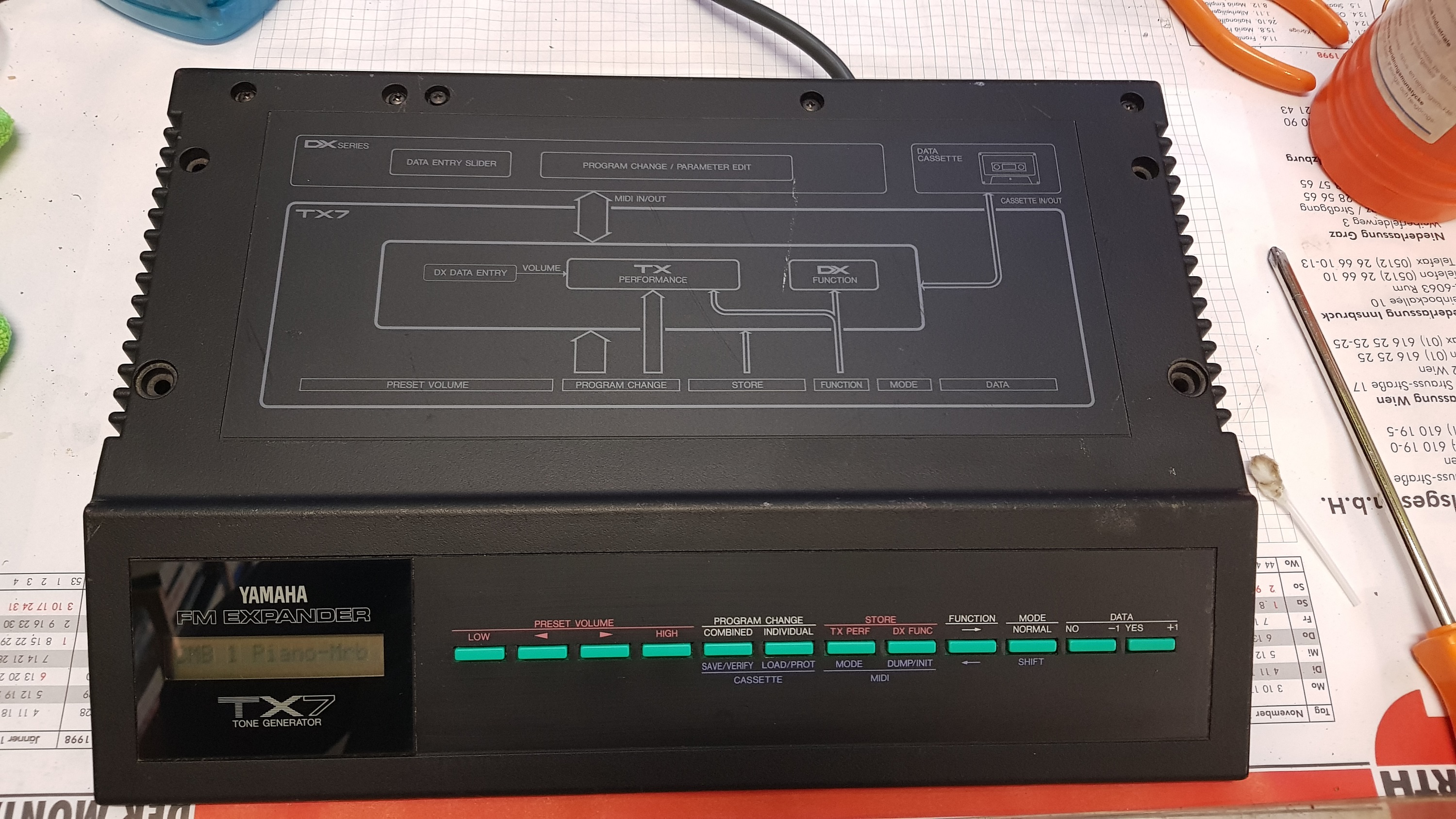
Yamaha TX7
The Yamaha TX7 is a desktop version of the DX7 MK1 released in 1985. As the front panels says, the TX7 is FM Expander for the DX7. Even if you can play it via MIDI stand alone for deeper sound manipulation you will need to connect it to a DX7 (or nowadays modify the patches with SYSEX).
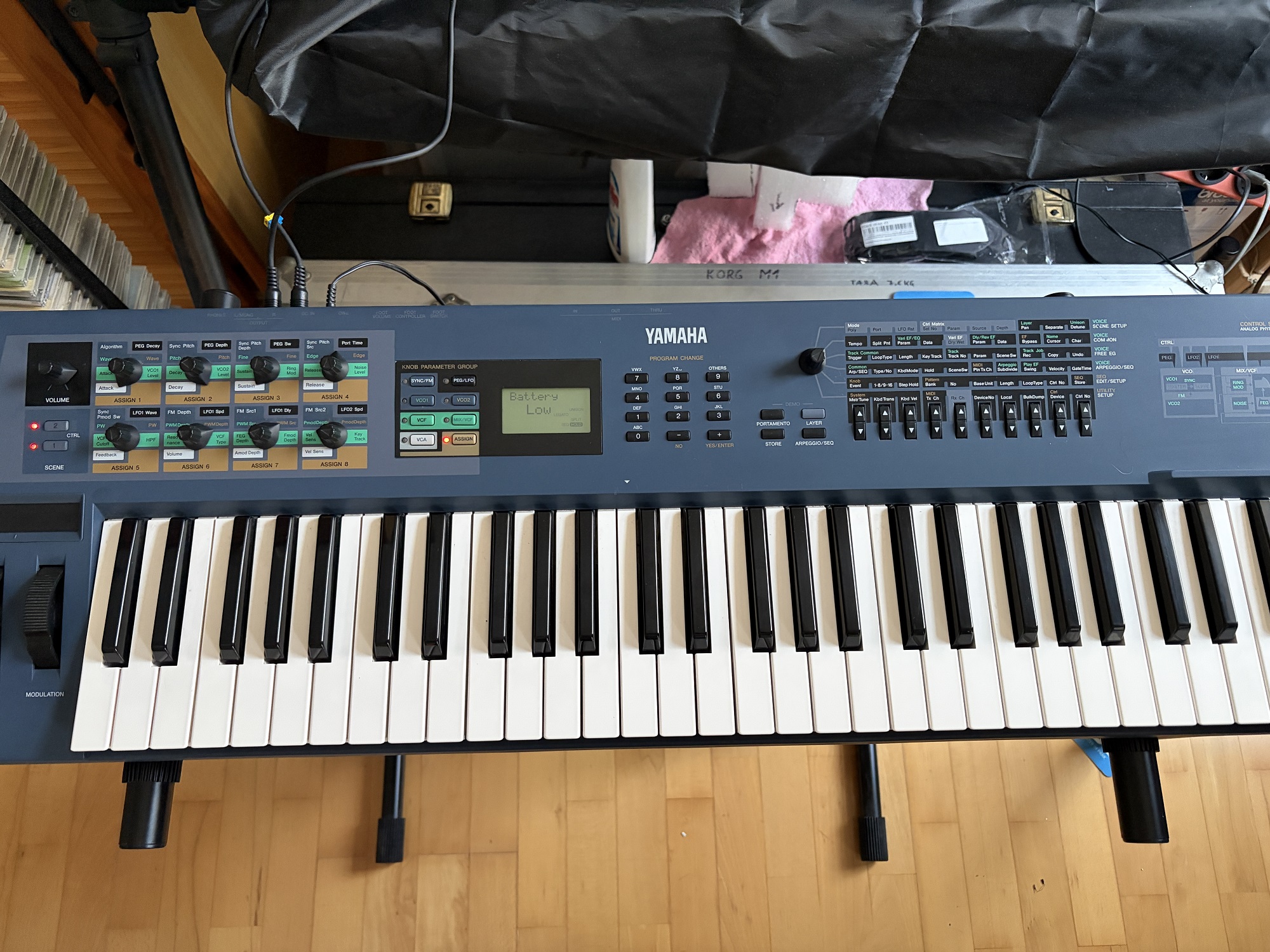
Yamaha AN1x
The Yamaha AN1x is a DSP-based analog modeling synthesizer (a.k.a. virtual analog synthesizer), produced by Yamaha Corporation from 1997 to 1998. Mine came in good condition and just needed a good cleaning and a new battery.
Roland D-50
Roland's answer in 1987 to the success of the Yamaha DX7 was the Roland D-50. Prices for the D-50 are stable but the memory cards are getting grazy. Does one buy a card with 88 patches for 100 EUR? Seriously? All OEM patches are available as SYSEX in the internet and can be loaded with MIDI anyway. How every, in the meantime I have the PN-D50-01, PN-D50-02 and PN-D50-03 in my collection and I'm still searching for 04 and 05. On both my D-50 I have replaced the tactile buttons and one needed a new volume slider.
Roland Alpha Juno II
The Roland Alpha Juno II expanded on the JU-1 by offering an additional octave of keys (making it a full 61 key synth), incorporating velocity sensitivity, aftertouch, and including a cartridge slot for patch storage. A factory preset called "WhatThe" became popular in rave, hardcore techno and jungle music, earning the moniker "Hoover sound" due to its distinctive pitch modulation effect. My JU-2 came with a broken volume slider therefore it was replaced.
Roland JUNO-D
This synthesizer from 2004 doesn't fit in the list, but it carries the name "Juno" in it even if it has nothing to do with that legacy. My JUNO-D went through a technical repair and is working fine now.

Roland JX-8P + PG800
The Roland JX-8P is a 61-key, velocity- and aftertouch-sensitive, six-note polyphonic, almost entirely analog synthesizer released by Roland in 1985. It was used by Europe in "Final Countdown". The PG800 is an external programmer and makes sound creation easier. My Roland JX-8P has really seen better days and still needs a lot of work. The PG800 was cleaned at is in condition.
Roland PRO-E
The Roland PRO-E is an arranger keyboard with 3 octaves from 1989. The case fits very well to the D-50.
Korg M1
As the best selling synthesizer I needed to have one (or two). One M1 was in quite rough shape and needed a LCD replacement. The other had some minor dings and dents but is looking OK now. I have replaced the tactile buttons on both M1.
Korg Poly-800
That little synth from 1983 is my first virtual analog synthesizer. Even it has just 5 seven segment digits, programming is quite easy. It has also strap pegs so you could play it like a keytar. Market prices for the Poly-800 are still low, I would add a MKII to my collection also.
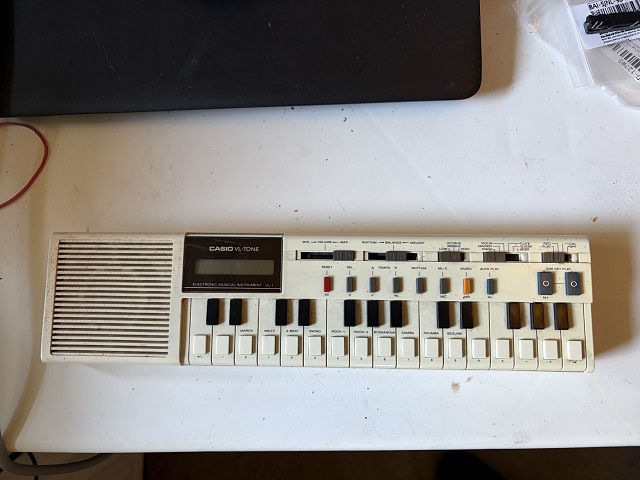
Casio VL-1 / Casio Tone-1
The VL-1 was the first instrument of Casio's VL-Tone product line, and is sometimes referred to as the VL-Tone. It combined a calculator, a monophonic synthesizer, and sequencer. Released in 1981, it was the first affordable commercial digital synthesizer, selling for $69.95. In Europe it is known to be used in the One Hit Single "Da Da Da" by the German Pop Group Trio.
Not a Synth: Behringer RX1602
To combine all the line signals I'm using a simple RX1602 to feed the combined signal to an amplifier.
Where do we go from here? My bucket list
I should not buy more gear, nevertheless I still observe the market for interesting gear.
History
First upload: 2026-04-03 | Version: 2026-09-10